

Depth Psychology as Medicine for Love, Logic & Soul.
I return a century-old discipline to plain speech, for readers who have outgrown influencers, recovery slogans, and the diagnostic scripts.

I am a depth psychology scholar at Pacifica Graduate Institute, specializing in Jungian and Archetypal Psychology. I am the author of Unlearning Love: Reclaiming Desire from Diagnosis and the publisher of Liber Rebis, a depth psychology newsletter.
Jae Botávn
Depth Psychology
Depth psychology is the branch of psychology that takes the unconscious seriously — not as a metaphor, but as a living structure that shapes how we love, what we fear, why we repeat what we swore we'd never repeat, and who we become when no one is watching.
It is over a century old. It begins with Freud's discovery that the mind conceals as much as it reveals, deepens through Jung's recognition that the unconscious is not merely personal but collective and archetypal, and arrives — through Hillman, von Franz, Whitmont, Singer, Edinger, and others — at a psychology that treats the soul as its own authority, not a problem to be managed.
Where mainstream psychology asks what is wrong with you, depth psychology asks what is trying to emerge. Where clinical models diagnose and correct, depth models allow and transmute.
The symptom is not the enemy. It is the messenger.
This is the tradition I work from.
Applied Symbolic Literacy
Most people navigate life through what I call borrowed identity: I am a conservative or liberal, I am a vegan or carnivore, I am an addict or sober, I am my diagnosis, I am my trauma. Others bypass the difficulty entirely — manifesting, toxic positivity, influencer worship — or by splitting the parts they cannot see in themselves and projecting them outward. Both reduce the psyche to something it is not.
Symbolic literacy is the alternative. The psyche—Latin for soul—speaks in images before it speaks in labels. Etymologically, ‘psychology’ means the essence of the soul. Learning to read your psyche’s images — in dreams, in symptoms, in the patterns we cannot stop repeating — is a skill other psychologies neglect.
That is what this work is for. What the Swiss psychiatrist C.G. Jung called individuation — and what James Hillman, founder of archetypal psychology, insisted begins not with the ego's growth plan, but with the soul's own imagination.
Descent Press
Liber Rebis, the newsletter that began here, has become Descent Press: an editorial house for depth psychology, where the essays now live alongside new work on culture, love, and the imaginal. Read and subscribe there.
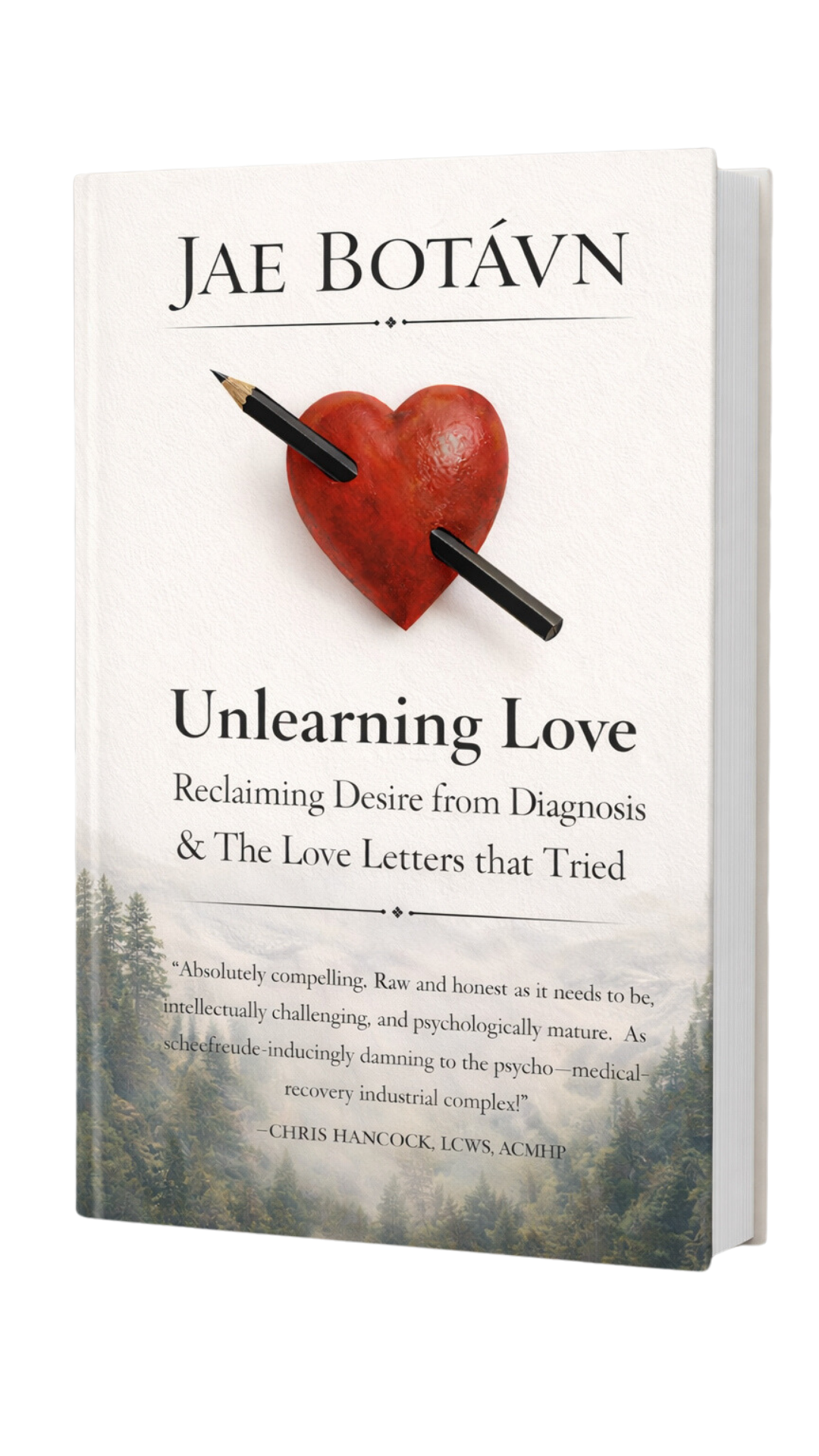
Unlearning Love
Real love letters. Chapters that dismantle the weaponized language of modern intimacy — "love addiction," "trauma bonding," "narcissist," "codependency."
This book doesn't offer recovery. It offers reclamation.
A nonfiction elegy, memoir, and polemic against the influencers, coaches, and celebrity psychologists who've turned human longing into pathology and sold fear as diagnosis.
A humanistic psychology of love that names patterns without collapsing them into identity. That translates suffering into symbolic clarity. That leaves you more sovereign than when you arrived.